Showing posts with label Sarah Gallick. Show all posts

Sunday, March 16, 2014

Saint Patrick of Ireland, 

March 17th 
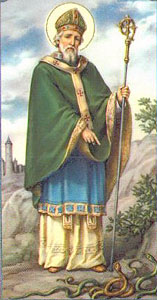
Picture from SantiBeati.com
     It’s time to celebrate Saint Patrick, apostle of the Irish.  He’s always portrayed in art as a gray-bearded bishop, in full regalia, driving the snakes out of Ireland.  But before he brought Christianity to Ireland, Patrick was a carefree teenager, growing up in a Roman colony on the coast of Wales.  He had probably been warned many times to stay away from the seashore, but he didn’t listen and so one day he was captured by Irish pirates and sold into slavery.  (Which I guess makes him the patron saint of kids who don’t listen to their parents.)

     Patrick spent six years tending to the sheep of a Druid chieftain, until an angel visited him in a dream and encouraged him to escape.  He walked 200 miles to Westport and found a ship that would take him back to Gaul.  After a series of misadventures, he reached home.  But he never forgot the Irish, he dreamed of them often and he yearned to return and bring them the True Faith.  With that in mind, he became a priest, then a bishop and was commissioned as the missionary to Ireland.  One previous mission had failed, and keep in mind, too that the Romans had never managed to conquer Ireland, either. 

     Many wonderful stories surround Patrick and way too many to share here.  He told some them in his Confession and the Epistle to the Soldiers of Coroticus.  There’s no doubt that he used the three-leafed shamrock to explain the mystery of the Trinity, nor is there any doubt that he loved his Faith and his adopted people.  So much so, it is said that he was granted a unique privilege: on Judgment Day, it will be Patrick who reviews the Irish.   

     Saint Patrick is the patron of the Archdiocese of New York and countless other churches throughout the world.  He is also the patron of engineers, because, according to tradition, he introduced Roman building techniques into Ireland.  

Thursday, February 27, 2014

Joseph of Cupertino—Patron of Astronauts

In the last few weeks I got to see the movie Gravity (starring Sandra Bullock as an astronaut marooned in space) and Hubble 3D, a short documentary about the real-life 2009 shuttle mission to repair the Hubble Space Telescope.  IMAX 3-D cameras accompanied the crew of five into space.  I watched from my comfortable seat in an Upper West Side theatre as they made five spacewalks to repair and upgrade the Hubble.  After the film, Mike Massamino, one of the astronauts seen in the film, spoke to us a little about the mission and the whole experience of outer space.

Joseph of Cupertino in a typical pose.
All this got me thinking about the patron of astronauts—Saint Joseph of Cupertino (1603-1663), sometimes called “the Flying Friar.” 

Joseph was born in the small village of Cupertino in the Kingdom of Naples and as a child he was labeled a dunce and a loser.  He was hot-tempered and given to ecstasies (religious trances) while in school.  Even his own mother considered him a fool.  He was apprenticed to a shoemaker but washed out.  He felt called to religious life but was rejected by the Conventual Franciscans.  (Astronaut Mike Massamino told us that he and several of his colleagues had been rejected numerous times before they were finally accepted into the space program.  It took some of them years, but, like Joseph, they refused to give up.) 

Joseph was finally accepted into a Capuchin monastery as a lay brother (a servant) but when he went into one of his ecstasies he would drop whatever he was holding.  After eight months and too many broken dishes, the Capuchins dismissed him as incompetent.  He left the monastery with nothing and headed home in rags.  On the way, a rich uncle refused to see him.  He reached Cupertino where even his mother scorned him.  The superior of the monastery of Grottela saw something in Joseph, however.  He let him stay in the monastery stable and look after their donkey. 

Joseph embraced this lowly task and impressed everyone with his cheerfulness and willingness to serve.  The superior thought he might make a religious after all.  A religious, maybe, but a student, no way.  He could only master one passage of Scripture well enough to explain it: “Blessed be the womb that bore Thee” [Luke 11:27].  Nevertheless, under circumstances that can only be called miraculous, he passed his examination for the diaconate and, a year later, the examination for the priesthood.  On March 4, 1628 he was ordained a priest. 

 “From the time of his ordination, Saint Joseph’s life was one long succession of ecstasies, miracles of healing and supernatural happenings on a scale not paralleled in the reasonably authenticated life of any other saint.”  (Butler’s Lives of the Saints).

Most remarkable was Saint Joseph’s power of levitation:  “he would fly straight from the church door to the altar over the heads of worshippers; once he flew to an olive tree and remained kneeling on a branch for half an hour.  Happenings like these were almost every day occurrences, witnessed by hundreds of persons.” (Book of Saints)

Not everyone understood or appreciated all this.  For thirty-five years Saint Joseph was not allowed to attend choir, dine with his fellow Franciscans, walk in procession or say Mass in church.  He was ordered to remain in his room where a private chapel was prepared for him.  He was even interrogated by the Inquisition.  The Franciscans kept him moving from one lonely monastery to another, but he kept on flying.   He arrived at Osimo in 1657 and died there peacefully at the age of sixty.  He was canonized in 1767. His feast day is September 18 and it's no surprise that he is also the patron of struggling students.  You can make a virtual tour of his shrine in Osima, Italy, here:  http://sangiuseppedacopertino.net/.  The pictures here are from www.santibeati.com.

Saturday, February 15, 2014

21st Century Martyrs


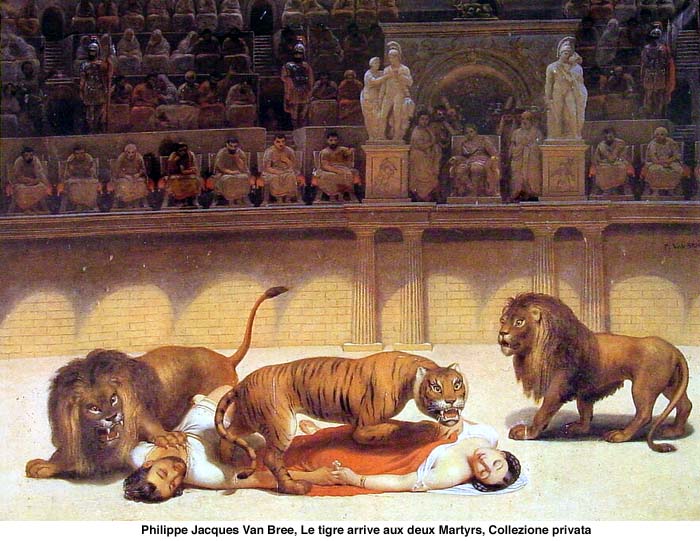
This amazing painting is from www.santibeati.com, but Christian martyrs are not just ancient history.  A brief item in The Tablet, a British weekly led me to a big story about the war on Christians today.    

On January 18, they cited the World Watch List, the annual report of a U.S.-based non-denominational group called Open Doors.  They report that documented cases of Christians martyred for their faith almost doubled in the year 2013 compared to 2012.  Most of these deaths occurred in several Muslim-majority countries. 

According to the Tablet,   "2,123 killings were credibly documented in 2013, after 1,201 the previous year, and the 1,213 deaths in Syria alone were more than all those reported in the whole world in 2012.  Other reports put numbers of martyred Christians in 2013 at as many as 8,000."  
 I couldn’t find the story on the Tablet’s website: http://www.thetablet.co.uk/  but  I tracked down the complete report here:  http://www.worldwatchlist.us/  


The awesome thing is that in spite of these persecutions, people still choose Christianity.  Their faith is strong.  Not much has changed since the 3rd century when Tertullian told us, “The blood of the martyrs is the seed of the Church.”   


Monday, February 10, 2014

St. Valentine, Patron of Lovers

This adorable cherub is not St. Valentine.  We actually don’t know a lot about the patron saint of lovers. We do know that he was martyred during the Roman persecutions, and the government did not keep very exact records while they were slaughtering hundreds of Christians.  According to tradition, Valentine was a priest and a physician who performed many miraculous healings before he was beheaded in 268 during the reign of Claudius the Goth.  His feast day has been kept on February 14 since ancient times. 

And there’s the connection to lovers:  Valentine’s Day falls right in the middle of a traditional 3-day Roman festival of Lupercalia when pagans celebrated the coming of spring and with it the urge to mate.    
By the Middle Ages Lupercalia was ancient history and February 14 was all about lovers exchanging tokens of affection.  The Victorians built on that with their beautiful greeting cards. We can also thank them for the chocolates. 
  

This is a relic of St. Valentine on display in Dublin where the Carmelites have a shrine dedicated to the patron saint of lovers.  http://www.carmelites.ie/stvalentine.html 

But don't think that martyrdom is a thing of the past.  Next post I'll tell you something about today's martyrs.  

Tuesday, July 8, 2008

Feast of Saint Kilian, Irish Martyr

Like many of the great Irish saints, Saint Kilian (c. 640 – 689) was a wanderer. Born in Ireland, he embraced the monastic life, which makes him one of those heroes celebrated by Thomas Cahill in “How the Irish Saved Civilization.” Yet Kilian felt called to be a missionary, and after a pilgrimage to Rome he was commissioned by Pope Conon as a kind of roving bishop. With eleven companions, he headed north to evangelize what is now Germany. Based in Wurzburg, he converted many of the local pagans to Christianity. His influence spread throughout the region that is now Bavaria, earning him the title “Apostle of Franconia.”

One of Kilian's most important converts was the Duke of Gosbert. The Duke was married to Geleina, the widow of his brother, and Kilian insisted that the marriage was invalid. Geleina decided to solve this problem by murdering Kilian. She waited until Gosbert was away to order the assassination, then tried to cover it up. One historian writes: “Geilana was seized with an evil spirit, which tormented her so much she died soon after.” At least one of Geleina’s thugs also went mad and died a horrible death. But the Christianity that Kilian had planted in Bavaria is still strong today and it is said that he personally intercedes for every citizen of Franconia, Germany, when they approach Heaven.

For some reason, the church I attended as a child in Farmingdale, Long Island, was called Saint Kilian’s, but the school was called Saint Killian’s. I seem to remember that the extra “L” was originally a misprint and the thrifty Dominican nuns and/or the Benedictine priests decided to just roll with it.

Saint Kilian might have enjoyed that. He was, after all, an Irishman, so he must have had a sense of humor.

I spent eight years at St Killian’s (a/k/a St Kilian’s) school and my class will mark a Very Important Anniversary in 2009. I’d love to hear from any of my former classmates who have probably traveled even further than St Kilian himself. I hope some of them will read this and e-mail me here.

Thursday, September 27, 2007

About Me

I am the author of six books and a founding member of Catholic Women at Work. My most recent work is THE BIG BOOK OF WOMEN SAINTS.

My articles have appeared in the New York Times, as well as Vogue, Harper's, and Star magazines and online at Godspy.com.

I live in New York City and love to give walking tours and talks on these courageous Catholic women who have become such an important part of my life. Read Full Profile